Jigoro Kano’s Educational Legacy Explored at International Conference in Tsukuba
The conference grew out of a long-standing partnership between the universities of Tsukuba (JPN) and Bordeaux (FRA). Its purpose was to explore Kano’s legacy not only as the history of a martial art but also in the contexts of education history, international exchange and the transmission of values.
Presentations on the first day examined a wide range of subjects, including women’s education and the place of women in judo, the philosophical foundations of Kano’s thought, Olympic education and judo’s role in helping people engage constructively with conflict. Contributions from countries including the UK, France, Italy, the United States, Argentina, Korea, Australia, the Netherlands, Slovenia, India, Mexico and Brazil demonstrated the many ways in which Kano’s ideas are interpreted in different contexts.
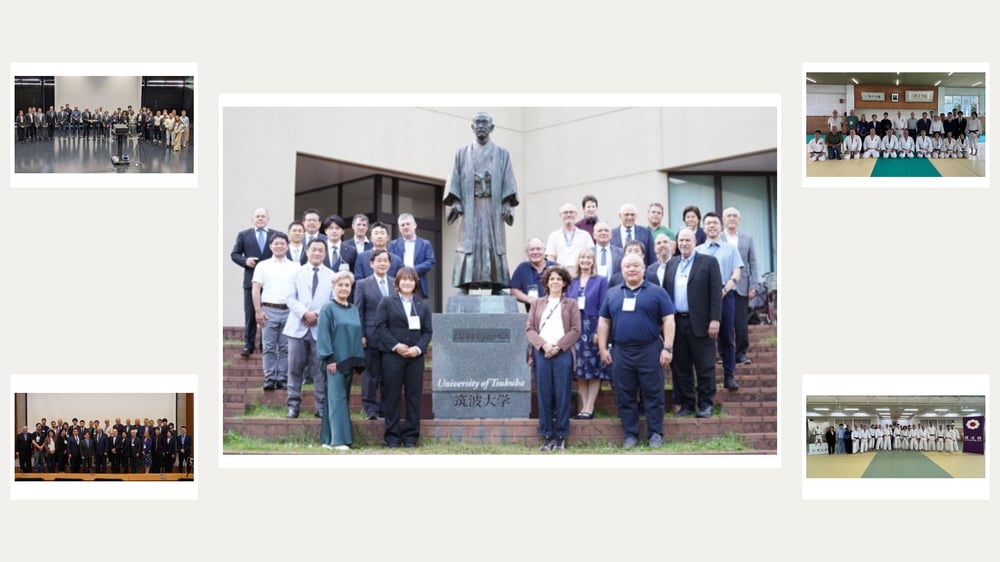
The programme also considered judo’s role in supporting communities after the Noto Peninsula earthquake and explored connections between Kano’s educational thinking and that of the Indian poet and philosopher Rabindranath Tagore.
Education took centre stage on the second day. Michel Brousse from the University of Bordeaux, a renowned expert in judo history, delivered a keynote address on preserving Kano’s legacy “from Meiji to Reiwa.” Other presentations explored judo as a tool for peace between peoples, a means of developing social skills from early childhood, and a foundation for virtue education. The discussions also drew on social psychology and physiology and considered an unexpected comparison between judo and esports.
For Michel Brousse, bringing different communities together was one of the conference’s defining strengths, “It was a first and I am very pleased that we brought together the university, the IJF and the Kodokan. Bringing academics and mat-based experts together worked very well and, above all, the participation was truly international.”
The final day connected discussion with practice. At the University of Tsukuba, participants observed a judo training session and practised Itsutsu-no-Kata. The programme then continued at the Kodokan in Tokyo with a lecture on Kano and Kodokan judo, a practical session on kata-based education, a visit to the museum and an opportunity to observe a children’s class.
Across three days, the conference showed how Kano’s educational legacy continues to travel and evolve. Its relevance lies in its capacity to be reinterpreted in response to the challenges of each time and place, a legacy that belongs to no single country, institution or generation.
read more
Similar news

Sakura Judo Lays New Paths in Kosovo for Women in Sport
Nov 16, 2026
Ten Years in Meheba and Still Dreaming
Nov 14, 2026
Belonging in Action: World Judo Day Across the World
Nov 2, 2026

Building Expertise and Strengthening Judo in Djibouti
Nov 2, 2026
Important updates
Top stories


The Next Generation Set to Shine in Tashkent
Nov 18, 2026

Ten Years of Making Room for One Another
Nov 17, 2026
Nov 16, 2026